

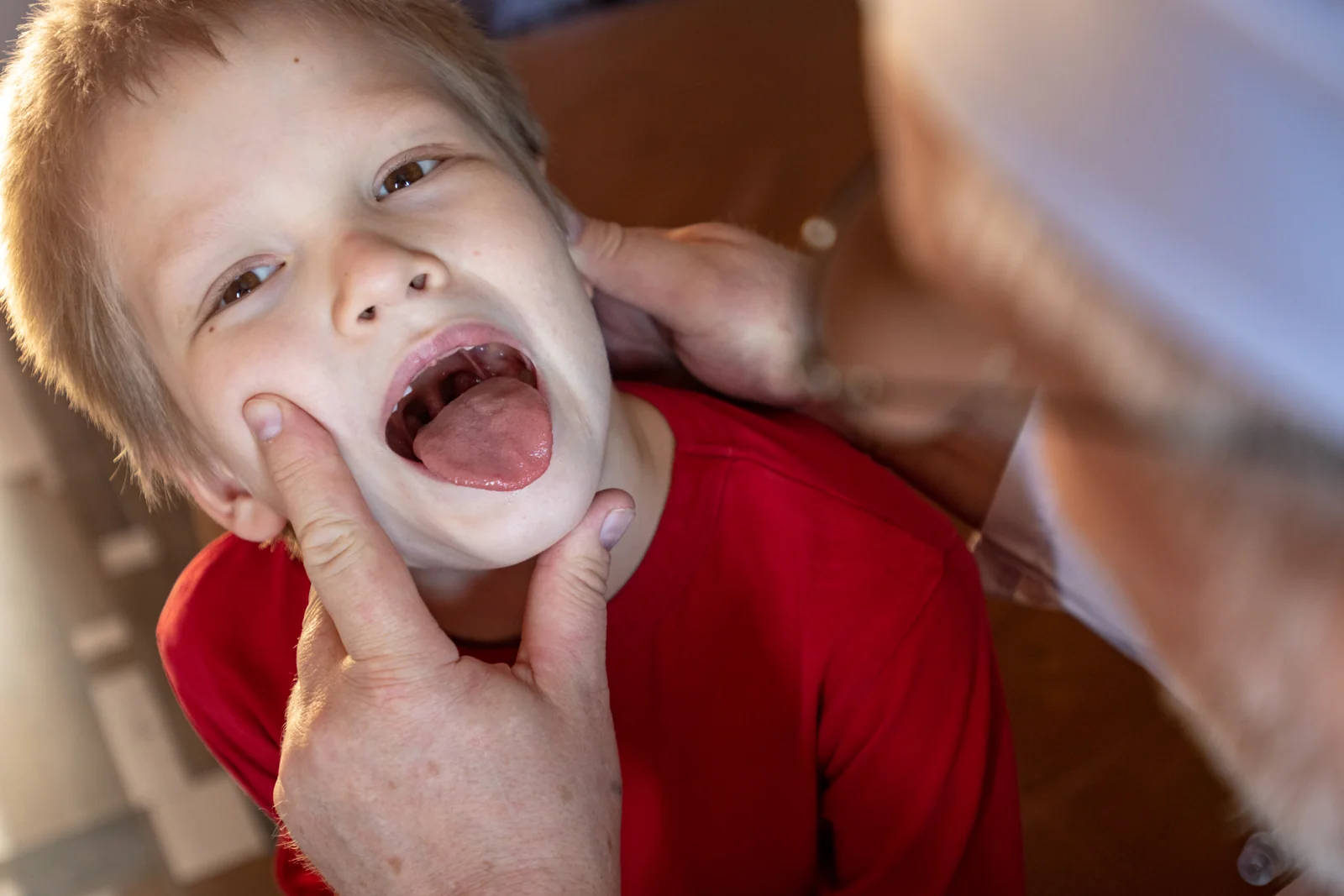
Quick answer:Myofunctional therapy for kids is an exercise-based program that retrains the muscles of the tongue, lips, and face to support nasal breathing, proper tongue posture, and healthy swallowing patterns. It helps children with orofacial myofunctional disorders — patterns like chronic mouth breathing, low tongue posture, and tongue thrust — and research supports it as a genuine adjunct to other care, including after tonsil or adenoid surgery, orthodontic treatment, or tongue-tie release, rather than a standalone cure for every oral or breathing concern.
This article is for general education and isn't a substitute for an in-person evaluation.
What Pediatric Myofunctional Therapy Actually Is
Myofunctional therapy — also called orofacial myofunctional therapy (OMT) — targets what's known as orofacial myofunctional disorders: patterns involving the oral and facial muscles that interfere with normal growth, development, or function, according to the American Speech-Language-Hearing Association. In children, this typically means addressing where the tongue rests when they aren't eating or talking, whether they breathe through the nose or mouth by default, how they swallow, and how the muscles around the lips and jaw work together.
What Does Myofunctional Therapy Help With?
| Pattern Addressed | What Therapy Works On |
|---|---|
| Chronic mouth breathing | Retraining nasal breathing as the default resting pattern |
| Low or forward tongue posture | Teaching the tongue to rest against the palate rather than low and forward |
| Tongue thrust | Correcting a forward-pushing swallow pattern that can affect tooth position |
| Open-mouth resting posture | Building lip seal strength to support closed-mouth rest |
| Orthodontic relapse risk | Addressing muscle patterns that can work against orthodontic results if left unaddressed |
| Sleep-disordered breathing, as an adjunct | Supporting breathing pattern alongside medical or surgical treatment, not replacing it |
Who Needs Myofunctional Therapy?
Signs that myofunctional therapy may be worth discussing include chronic mouth breathing during the day or at night, snoring or restless sleep, a persistent open-mouth resting posture, tongue thrust when swallowing, speech sound difficulties connected to tongue placement, prolonged thumb-sucking or pacifier use beyond toddlerhood, and dental crowding or orthodontic relapse after previous treatment. None of these signs alone confirms a child needs therapy — an evaluation determines whether the underlying pattern is significant enough to address directly.
What the Research Actually Shows
A systematic review examining orofacial myofunctional therapy's effects on craniomaxillofacial growth in children with obstructive sleep apnea found it to be a valuable adjunct therapy, particularly for children with existing craniofacial differences, when used alongside other treatment rather than in isolation. More recent research has specifically examined OMT's role after adenotonsillectomy (surgical removal of enlarged tonsils and adenoids) — finding that children who didn't receive myofunctional therapy after surgery to address lingering mouth breathing showed significantly higher sleep apnea severity months later compared to children who did receive it. This is a meaningful, specific finding: for some children, surgery alone doesn't fully resolve the breathing pattern, and myofunctional therapy plays a genuine role in supporting the result afterward.
Pediatric obstructive sleep apnea itself is estimated to affect roughly 1% to 5% of children without underlying syndromes, though prevalence is dramatically higher — estimated between 30% and 90% — in children with Down syndrome, a population where myofunctional therapy is an active area of current research specifically because of this elevated risk.
How This Is Different From Speech Therapy
Myofunctional therapy and speech therapy overlap but aren't the same thing. Speech therapy addresses how sounds and language are produced. Myofunctional therapy addresses the underlying muscle function and resting posture — where the tongue sits, whether the lips close at rest, and how a child swallows — which can influence speech but is a distinct area of focus. Some children benefit from both, particularly when a muscle pattern like tongue thrust is contributing to a specific speech sound difficulty.
How Myofunctional Therapy Fits With Other Care
Myofunctional therapy works best as part of a coordinated plan rather than in isolation. If chronic mouth breathing is part of what's prompting your interest in therapy, our guide on why your child may be mouth breathing at night covers that pattern directly, and if a tongue-tie is restricting normal tongue posture, our Tongue Tie Surgery page covers how that evaluation fits alongside myofunctional support. Our Myofunctional Therapy page covers our specific approach to evaluation and treatment in more detail.
Frequently Asked Questions
At what age can a child start myofunctional therapy?
There's no strict minimum age, though therapy is typically most effective once a child can actively participate in and practice exercises, often starting around ages 4 to 5, though this varies by individual readiness.
Does myofunctional therapy replace the need for orthodontic treatment?
No. It addresses muscle function and habit, not tooth position or jaw structure directly. It's often used alongside orthodontic treatment rather than instead of it.
Can myofunctional therapy help after a tongue-tie release?
Yes, often. Releasing a tongue-tie frees up movement, but retraining the tongue to actually use that new range of motion is a separate step that myofunctional therapy addresses.
What does myofunctional therapy help with the most reliably?
Research most consistently supports it as an adjunct for mouth breathing, tongue posture, and swallowing pattern, and increasingly as a supportive therapy following tonsil/adenoid surgery — rather than as a standalone cure for every related concern.
Getting Started
If you've noticed signs of chronic mouth breathing, tongue thrust, or an open-mouth resting posture in your child, an evaluation can determine whether myofunctional therapy is an appropriate part of their care. Schedule an evaluation to get a clear, individualized recommendation.
References
- American Speech-Language-Hearing Association (ASHA). Orofacial Myofunctional Disorders. ASHA Practice Portal. https://www.asha.org/practice-portal/clinical-topics/orofacial-myofunctional-disorders/
- The Effects of Orofacial Myofunctional Therapy on Children with OSAHS's Craniomaxillofacial Growth: A Systematic Review. Children, PMC, National Library of Medicine. https://www.ncbi.nlm.nih.gov/pmc/articles/PMC10136844/