
Quick answer:A child can sleep 10 or more hours and still wake up unrested. The most common signs of poor-quality sleep in children are snoring, mouth breathing, restless tossing and turning, night sweats, and bedwetting at night, plus fatigue, irritability, trouble focusing, or morning headaches during the day. When several of these show up together, they can point to sleep-disordered breathing, a group of conditions that includes pediatric obstructive sleep apnea (OSA). These signs are worth raising with your child's pediatrician or an airway-focused provider.
This article is for general education and isn't a substitute for an in-person evaluation.
Restorative Sleep in Children: Why Hours Alone Don't Tell the Whole Story
Restorative sleep is sleep deep and continuous enough for the brain and body to recover. A child can be in bed for the recommended number of hours and still miss that recovery if sleep is repeatedly interrupted.
The most common disruptor is a partially blocked airway. According to Cleveland Clinic, when a child's brain senses a change in breathing during sleep, it briefly rouses the child to restart normal breathing. Those micro-awakenings are usually too short for the child to remember, but they fragment sleep and can leave a child tired the next day. This is why a child who "sleeps all night" may not actually be sleeping well.
Nighttime Signs Your Child Isn't Sleeping Well
The clearest nighttime signs of poor sleep quality involve how a child breathes and moves while asleep. Cleveland Clinic lists each of the signs below as possible symptoms of childhood sleep apnea.
| Nighttime Sign | What to Look or Listen For |
|---|---|
| Snoring or loud breathing | Regular snoring, not just during a cold, or breathing you can hear from the doorway |
| Mouth breathing | Lips apart and mouth open for most of the night instead of breathing through the nose |
| Pauses, gasps, or choking | Breathing that stops briefly, then restarts with a snort, cough, or gasp |
| Restless sleep | Frequent tossing and turning, tangled sheets, or waking in unusual positions |
| Night sweats | Damp hair or pajamas in a room that isn't overly warm |
| Sleepwalking or sleep talking | Episodes that happen often rather than occasionally |
| Bedwetting | Wetting the bed after a child has been reliably dry at night |
One sign on its own is rarely cause for alarm. A pattern of several signs, repeated most nights, is the stronger reason to talk with a provider.
Daytime Symptoms of Poor-Quality Sleep in Children
Daytime symptoms are often what parents notice first, because they show up at school, at home, and in mood. Cleveland Clinic identifies fatigue, inattention, irritability or behavioral problems, and morning headaches as daytime clues that a child may have sleep apnea.
| Daytime Symptom | How It Often Shows Up |
|---|---|
| Fatigue | Hard to wake in the morning, dozes in the car, or seems drained despite a full night in bed |
| Trouble focusing | Teachers report inattention, or homework takes far longer than it should |
| Irritability or meltdowns | Short fuse, frequent tantrums, or aggression that seems out of character |
| Hyperactivity | Constant motion and difficulty settling, especially later in the day |
| Morning headaches | Complaints of a headache soon after waking that fade as the day goes on |
| Dark circles under the eyes | Persistent shadows that don't improve with an earlier bedtime |
Unlike adults, sleep-deprived children don't always look sleepy. Many become more active and harder to settle, which can make the connection to sleep easy to miss.
Why Open-Mouth Sleeping and Mouth Breathing Deserve Attention
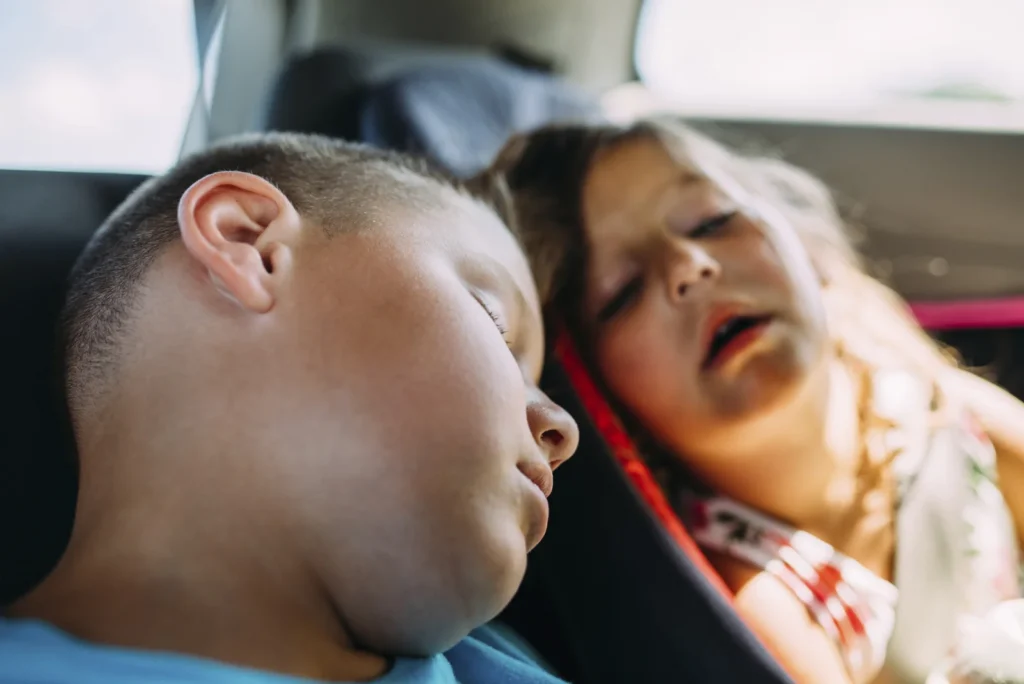
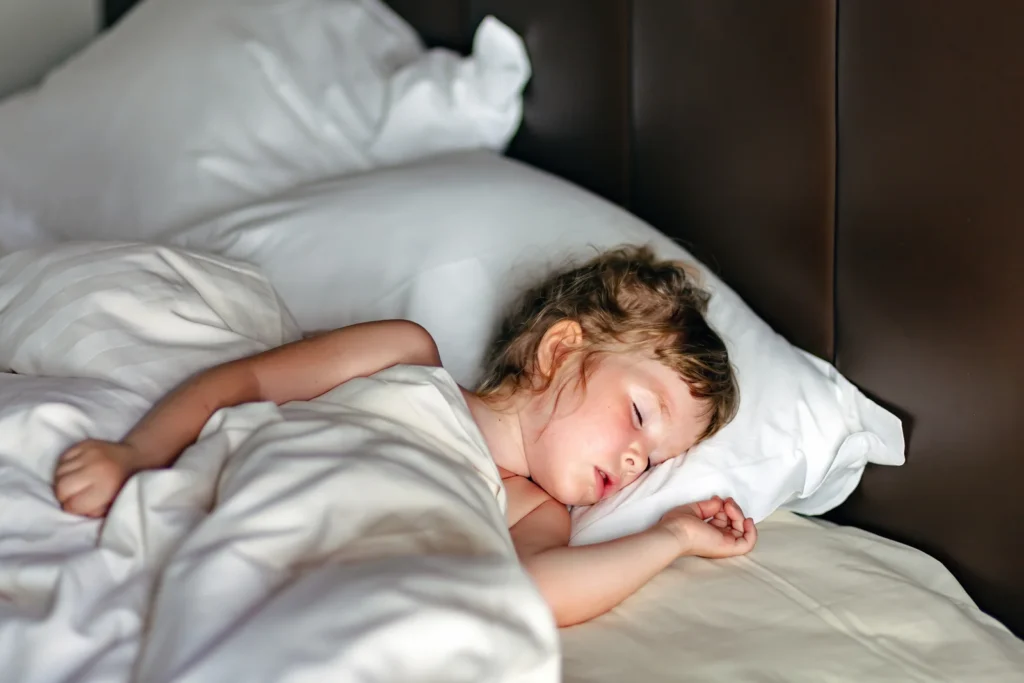
Open-mouth sleeping is one of the easiest signs for parents to spot, and one of the most commonly overlooked. Children normally breathe through the nose during sleep. A child who consistently sleeps with the mouth open may be compensating for a nasal passage or airway that isn't moving air easily.
Several factors can narrow a child's airway. Cleveland Clinic names enlarged tonsils or adenoids as a common cause of obstructive sleep apnea in children, along with facial bone structure, such as a small jaw or an overbite. Allergies, asthma, and frequent upper respiratory infections are also listed as risk factors. Because the jaws, palate, and airway develop together, a pediatric dentist may notice related signs during a routine exam, such as a narrow palate, crowding, or worn teeth from nighttime grinding.
How Poor Sleep Quality Can Look Like Attention or Behavior Problems
Fragmented sleep can affect a child's attention, mood, and behavior in ways that overlap with other concerns. Cleveland Clinic lists attention-deficit/hyperactivity disorder (ADHD) among the possible complications of untreated childhood sleep apnea and notes that disrupted sleep can affect behavior, emotional capacity, and academic performance.
This doesn't mean every child with attention or behavior concerns has a sleep problem. It does mean sleep quality is worth asking about when a child's focus or mood changes, particularly if nighttime signs like snoring or mouth breathing are also present.
How Children Are Evaluated for Sleep-Disordered Breathing
Sleep-disordered breathing in children is common but often missed. A 2024 review in PMC, National Library of Medicine describes pediatric OSA as affecting roughly 1% to 5% of children worldwide and frequently going undiagnosed. The same review notes that many children who snore or have large tonsils do not have OSA, which is why a careful evaluation matters more than any single symptom.
Evaluation typically involves several providers, each with a different role:
| Provider | Role in Evaluating Your Child's Sleep |
|---|---|
| Pediatrician | Reviews sleep history and symptoms, performs a physical exam, and coordinates referrals |
| Sleep physician | Orders and interprets an overnight sleep study (polysomnography), the test used to diagnose OSA |
| Ear, nose, and throat (ENT) specialist | Assesses tonsils, adenoids, and the nasal passages |
| Airway-focused pediatric dentist | Screens for oral and facial signs linked to airway concerns and coordinates with medical providers |
A dentist does not diagnose sleep apnea. An airway-focused pediatric dentist can, however, help identify children who may benefit from further evaluation and support treatment planning alongside the child's medical team. Families in the Dallas area can learn more about this approach on our airway health and sleep-disordered breathing page.
When to Talk to a Provider About Your Child's Sleep
Schedule an evaluation if your child snores or mouth-breathes most nights, you've noticed pauses in breathing, or daytime fatigue and behavior changes persist despite a consistent bedtime. Cleveland Clinic specifically recommends seeing a provider if a child wakes often during the night or has interruptions in breathing while asleep.
Seek emergency care right away if your child is having trouble breathing, or if their skin, lips, or nails look pale, blue, or gray.
Frequently Asked Questions
Is it normal for a child to snore?
Occasional snoring during a cold or allergy flare is common. Snoring that happens most nights, or comes with pauses, gasping, or mouth breathing, is worth mentioning to your child's pediatrician.
Can a child have sleep apnea without snoring loudly?
Snoring is the most recognized sign, but it isn't the only one. Mouth breathing, restless sleep, night sweats, and daytime behavior changes can also be clues.
Will my child grow out of mouth breathing?
Some children do, particularly if the cause is temporary congestion. According to Cleveland Clinic, children with mild sleep apnea may outgrow it as throat tissue shrinks with age, but persistent symptoms should be evaluated rather than waited out.
Can a pediatric dentist help with sleep problems?
A pediatric dentist can't diagnose a sleep disorder, but an airway-focused dentist can screen for oral and jaw-related signs and work with your child's pediatrician, ENT, or sleep physician on next steps.
Getting Your Child's Sleep Evaluated in Dallas
If your child sleeps through the night but still wakes up tired, breathes through the mouth, or struggles with focus and mood, those patterns are worth a closer look. Beyond Pediatric Dentistry in Dallas, TX, screens for airway-related signs and coordinates with your child's pediatrician and other providers when further evaluation is needed. Contact our office to schedule a visit.
References
- Cleveland Clinic. Obstructive Sleep Apnea in Children. Cleveland Clinic Health Library. https://my.clevelandclinic.org/health/diseases/14312-obstructive-sleep-apnea-in-children
- Pediatric Obstructive Sleep Apnea: Diagnostic Challenges and Management Strategies. PMC, National Library of Medicine. https://www.ncbi.nlm.nih.gov/pmc/articles/PMC11649035/